- JSP Code Example Demonstrates Javascript HTML Injection
- How to HTML-encode in the JSP expression language?
- In HTML page can we use jsp code
- Convert JSP to HTML
- HTML Tag injection in asp.net
- Introduction to Java Server Pages – JSP Tutorial
- Your First JSP
- Servlet Vs JSP
- Advantages of JSP
- Architecture of a JSP Application
- Top Related Articles:
- About the Author
- Comments
JSP Code Example Demonstrates Javascript HTML Injection
JSP is a server-side technology that enables the rendering of views. Its advantage over HTML lies in its support for JSTL and EL, as well as the ability to embed Java code. Unlike HTML, JSP does not have any special tags and supports all HTML tags. It should be noted that JSP is a server-side scripting language, while HTML is a client-side scripting language. Therefore, embedding JSP code in HTML and sending it to the user’s browser will not work.
How to HTML-encode in the JSP expression language?
Javascript — HTML Tag injection in asp.net, HTML tag injection vulnerabilities were identified on this web application. HTML tag injections are used to aid in Cross-Site Request Forgeries and phishing attacks against third-party web sites, and can often double as Cross-Site Scripting vulnerabilities. Recommendations include implementing secure …
In HTML page can we use jsp code
Server-side code cannot be executed in the browser and must be executed on the server. There is a clear distinction between server-side processing and client-side processing, which means that JSP code cannot interact with JavaScript code or any other client-side code.
To execute server-side code in an HTML file prior to rendering it to the browser, the server must be configured to process such code. Configuring the web server, whichever one you use, is essential. The default configuration merely delivers .html files to the browser without any server-side processing. However, you can configure the web server to handle .html files similarly to JSP files.
It’s important to note that handling .html files requires the same approach as JSP files. You must adhere to the standard practices for segregating client-side and server-side code.
By mapping the content type text/html to JSP in your web server configuration, you will be able to accomplish this task.
JSP pages are not processed on the client side but on the server side. They generate HTML, which is then transmitted to the browser. Like PHP, JSP essentially creates HTML code, which is then sent to the user. Embedding JSP code in HTML and sending it to the user is not possible, as their browser will not recognize it.
Preventing HTML and Script injections in, What I’m really asking here is if there is a standard method of avoiding both HTML and Script injection in Javascript. Javascript/Html: appending to section as text not html code-1. Avoiding sending message with html tags making elements. 250. How to display HTML tags as plain text. 121.
Convert JSP to HTML
JSP files are server-side technology used for rendering views, whereas HTML lacks this capability.
The objective is to ensure that the jsp files incorporate numerous tags.
JSP does not possess any unique tags as mentioned; instead, it supports all HTML tags.
Is it possible to transform a JSP file into an HTML format?
Given that JSP is a scripting language for server-side operations, while HTML is a scripting language for client-side operations, it may be challenging to achieve the desired outcome.
The HTML files are static and can be served quickly and effortlessly.
The loading time of HTML is comparatively faster as it operates locally, while JSP may take a while to load because it needs to communicate with the web server.
If your JSP pages are static, the simplest approach is to establish an HTTP connection to your server and obtain the page source code in the final output. However, this method is not suitable for dynamic pages, as the content will be subject to change.
Using JSP pages for static content is illogical. However, if your content is dynamic, it’s essential to examine why the pages are loading slowly. Consider evaluating the methods used to link the dynamic data to the JSP pages or retrieve the information.
How to HTML-encode in the JSP expression language?, How to HTML-encode in the JSP expression language? The value of $
HTML Tag injection in asp.net
While the previous solution may be effective for URLs due to the inclusion of HTML and Javascript escape characters in the built-in URL encoding, it does not provide a comprehensive resolution for incorporating variable server-side values in Javascript. Hence, I have shared my solution to prevent others from making the mistake of using an incorrect encoding method and potentially creating a security risk.
To avoid switching out of the data value, all characters below 256, except alphanumeric characters, must be escaped using the \xHH format. It is important not to use escaping shortcuts like \» because they can be matched by the HTML attribute parser, which runs first. These shortcuts are also vulnerable to «escape-the-escape» attacks where the attacker sends \» and the vulnerable code turns that into \», enabling the quote.
One simpler solution is to avoid placing server-side data in script tags or script-enabled attributes. Instead, HTML5 data attributes can be utilized to insert the data into a more secure HTML context after encoding it.
It seems like you’re utilizing JQuery. Instead, consider using the ASP.NET encoding functions that are already integrated, would you like to give it a try?
function ClosePopUp(objBhID) < var pageName = window.location.pathname; var modalPopupBehavior = $find(objBhID); if (modalPopupBehavior != null && modalPopupBehavior != 'undefined') < modalPopupBehavior.hide(); >if (objBhID == 'bhThankMsg' && pageName == '/Projects/Comm.aspx') < var objPartnerID = $('#myDynamicData').data('partnerId'); var if (objPartnerID) < window.location = '/Projects/Comm.aspx?Id=' + encodeURIComponent(id) + '&partnerid=' + encodeURIComponent(objPartnerID); >else < window.location = '/Projects/Comm.aspx?Id=' + encodeURIComponent(id); >> > How to Inject JavaScript Code to Manipulate, Locating DOM Elements and Creating the Injection Code. Open your Chrome developer tools by pressing F12, then identify the element with the pop-up. In this example, the iframe element with ID wallIframe contains the pop-up with some fading background in the back. Now, we’ll be using a small JavaScript …
Introduction to Java Server Pages – JSP Tutorial
JSP is a server side technology that does all the processing at server. It is used for creating dynamic web applications, using java as programming language. It is an extension of servlet because it provides more functionality than servlet by allowing users to use expression language and JSTL.
Basically, any html file can be converted to JSP file by just changing the file extension from “.html” to “.jsp”, it would run just fine. What differentiates JSP from HTML is the ability to use java code inside HTML. In JSP, you can embed Java code in HTML using JSP tags. for e.g. run the code below, every time you run this, it would display the current time. That is what makes this code dynamic.
Hello BeginnersBook Readers! Current time is:
Your First JSP
Let’s start learning JSP with a simple JSP.
The above JSP generates the following output:
Hello, Sample JSP code.
Explanation of above code
1) The line represents the JSP element called JSP Comment, While adding comments to a JSP page you can use this tag, we will discuss this in detail in coming posts.
Note: JSP Comments must starts with a tag and ends with –%>
2) Head, Title and Body tags are HTML tags – They are HTML tags, frequently used for static web pages. Whatever content they have is delivered to client(Web browser) as such.
3) is a JSP element, which is known as Scriptlet. Scriptlets can contain Java codes. syntax of scriptlet is: . As the code in Scriptlets is java statement, they must end with a semicolon(;). out.print(“ Hello, Sample JSP code ”) is a java statement, which prints“ Hello, Sample JSP code”.
As discussed, JSP is used for creating dynamic webpages. Dynamic webpages are usually a mix of static & dynamic content.
The static content can have text-based formats such as HTML, XML etc and the dynamic content is generated by JSP tags using java code inside HTML .
Servlet Vs JSP
Like JSP, Servlets are also used for generating dynamic webpages. Here is the comparison between them.
The major difference between them is that servlet adds HTML code inside java while JSP adds java code inside HTML. There are few other noticeable points that are as follows:
Servlets:
- Servlet is a Java program which supports HTML tags too.
- Generally used for developing business layer(the complex computational code) of an enterprise application.
- Servlets are created and maintained by Java developers.
- JSP program is a HTML code which supports java statements too.To be more precise, JSP embed java in html using JSP tags.
- Used for developing presentation layer of an enterprise application
- Frequently used for designing websites and used by web developers.
Advantages of JSP
- JSP has all the advantages of servlet, like: Better performance than CGI Built in session features, it also inherits the the features of java technology like – multithreading, exception handling, Database connectivity etc.
- JSP Enables the separation of content generation from content presentation. Which makes it more flexible.
- With the JSP, it is now easy for web designers to show case the information what is needed.
- Web Application Programmers can concentrate on how to process/build the information.
- It is easy to manage as business logic can be separated with presentation logic.
Architecture of a JSP Application
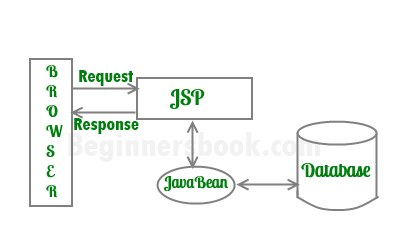
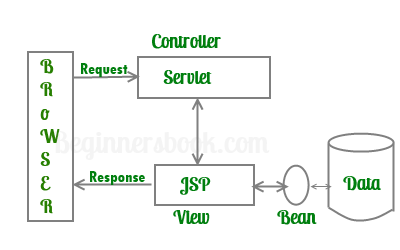
Before we start developing web application, we should have a basic idea of architectures. Based on the location where request processing happens (Servlet OR JSP(java server pages)) there are two architectures for JSP. They are – Model1 Architecture & Model2 Architecture.
1) Model1 Architecture: In this Model, JSP plays a key role and it is responsible for of processing the request made by client. Client (Web browser) makes a request, JSP then creates a bean object which then fulfils the request and pass the response to JSP. JSP then sends the response back to client. Unlike Model2 architecture, in this Model most of the processing is done by JSP itself.
2) Model2 Architecture: In this Model, Servlet plays a major role and it is responsible for processing the client’s(web browser) request. Presentation part (GUI part) will be handled by JSP and it is done with the help of bean as shown in image below. The servlet acts as controller and in charge of request processing. It creates the bean objects if required by the jsp page and calls the respective jsp page. The jsp handles the presentation part by using the bean object. In this Model, JSP doesn’t do any processing, Servlet creates the bean Object and calls the JSP program as per the request made by client.
Top Related Articles:
About the Author
I have 15 years of experience in the IT industry, working with renowned multinational corporations. Additionally, I have dedicated over a decade to teaching, allowing me to refine my skills in delivering information in a simple and easily understandable manner.
Comments
thanks I find your website better than my book, its easy to learn and understand . Each point is clear, great work admin. I have following three questions with respect to JSP. Could you please provide me the answers?
1) Can we implement an interface in a JSP?
2) Difference between ServletContext and ServletConfig?
3) How to disable session in JSP?
Hey Zoyeb, Thanks for stopping by. Here are the answers:
1) No we cannot implement an interface in a JSP page. We are only allowed to extend a class in JSP using extends attribute of page directive
2) The major two differences between ServletContext and ServletConfig are as follows:
a) ServletConfig gets created every time during creation of a Servlet while ServletContext gets created only once per web application.
b) ServletConfig is used to access the ServletContext while ServletContext is used to access the server information.
3) This is how you can disable the session on a JSP page:
Setting up the session attribute of page directive to false. I have already covered this in the page directive section of this tutorial.
Hi Chaitanya,
I am confused after watching request handling architecture here . As per my understanding request from browser first handled by jsp container which converted jsp into servlet and then compiled servlet class executed and send back response to client through web container. So jsp must be on second step of architecture. Please clarify soon. Thanks
Abhinav
Hello Abhinav the use of bean classes is only to set and get the values by using setter and getter methods… We can use this terminology in every Java technology